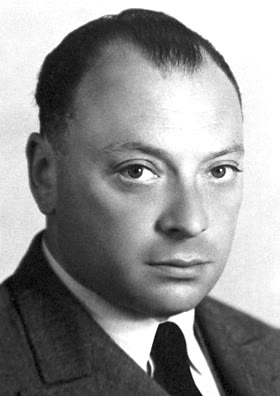
Wolfgang Pauli
Physicist, Nobel prize winner (1900–1958)
- EnglishRead in your language
- CitedEvery fact sourced
- Ad-freeNo ads, no tracking
Wolfgang Ernst Friedrich Pauli was an Austrian theoretical physicist and a pioneer of quantum mechanics. In 1945, after having been nominated by Albert Einstein, Pauli received the Nobel Prize in Physics "for the discovery of the Exclusion Principle, also called the Pauli Principle". The discovery involved spin theory, which is the basis of a theory of the structure of matter.
Quick facts
Awards wd
- Lorentz Medal (1931)
- Nobel Prize in Physics (1945)
- Max Planck Medal (1958)
- Matteucci Medal (1956)
- Franklin Medal (1952)
- honorary doctor of the University of Vienna
- Foreign Member of the Royal Society (1953)
- professor (1926)
- honorary doctor of the University of Hamburg (1958)
People also search for
 Albert A. Michelson
 Enrico Fermi
 Maria Goeppert Mayer
 Robert Millikan
 Steven Weinberg
 Erwin Schrödinger
 Eugene Wigner
 Hendrik Lorentz
 Henri Becquerel
 J. J. Thomson
 James Chadwick
 Johannes Diderik van der Waals
Questions
- When was Wolfgang Pauli born?
- Wolfgang Pauli was born on 25 April 1900 in Vienna.
- Where did Wolfgang Pauli study?
- Wolfgang Pauli was educated at LMU Munich, Bundesgymnasium Döbling.
Sources
- Wikipedia (English): Wolfgang Pauli · CC BY-SA 4.0
- Wikidata item Q65989 · CC0 1.0
- Image: Pauli.jpg by Nobel foundation (Public domain)

Last updated · facts checked 18 November 2026
Cite this page
"Wolfgang Pauli". DigiNepal. Last updated 17 November 2026. https://diginpl.com/people/wolfgang-pauli. Retrieved 20 November 2026.
Text from the Wikipedia article Wolfgang Pauli, licensed under CC BY-SA 4.0. This page's text is shared under the same licence. Facts from Wikidata (CC0). Image: Pauli.jpg — Nobel foundation, Public domain.
Is this you, or do you work in this person's office? Claim this profile