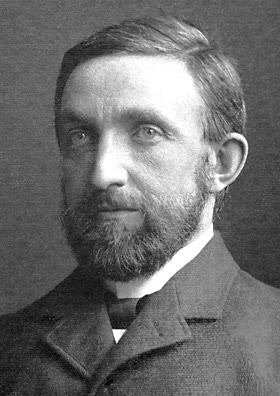
Philipp Lenard
German physicist (1862–1947)
- EnglishRead in your language
- CitedEvery fact sourced
- Ad-freeNo ads, no tracking
Philipp Eduard Anton von Lenard was a German experimental physicist who received the Nobel Prize in Physics in 1905 for his work on cathode rays. This work led to his experimental realization of the photoelectric effect, discovering that the energy (speed) of the electrons ejected from a cathode depends only on the frequency and not the intensity of light.
Quick facts
Positions held wd
- professor
Awards wd
- Nobel Prize in Physics (1905)
- Golden Party Badge
- Rumford Medal (1896)
- Matteucci Medal (1896)
- Franklin Medal (1932)
- honorary doctor of Comenius University (1942)
- honorary member of the Physics Association (Frankfurt am Main, Germany) (1895)
People also search for
 Alexander Graham Bell
 C. K. Prahalad
 Arjun Narasingha KC
 Masatoshi Koshiba
 Rolf M. Zinkernagel
Questions
- When was Philipp Lenard born?
- Philipp Lenard was born on 7 June 1862 in Bratislava.
- What positions has Philipp Lenard held?
- Positions held by Philipp Lenard include: professor.
- Where did Philipp Lenard study?
- Philipp Lenard was educated at Heidelberg University, Gymnasium Grösslingová.
Sources
- Wikipedia (English): Philipp Lenard · CC BY-SA 4.0
- Wikidata item Q57063 · CC0 1.0
- Image: Lenard.jpg by Unknown author Unknown author (Public domain)

Last updated · facts checked 18 November 2026
Cite this page
"Philipp Lenard". DigiNepal. Last updated 17 November 2026. https://diginpl.com/people/philipp-lenard. Retrieved 20 November 2026.
Text from the Wikipedia article Philipp Lenard, licensed under CC BY-SA 4.0. This page's text is shared under the same licence. Facts from Wikidata (CC0). Image: Lenard.jpg — Unknown author Unknown author, Public domain.
Is this you, or do you work in this person's office? Claim this profile